
disseminated on Facebook by the Romanian UNESCO Parliamentary Commission.
For this work, I produced
a painted reproduction of a photographic image of “Princess X,” deliberately pixelating the image so that it appears censored, thereby
introducing a mechanism of visual suppression directly associated with
the logic of social media platforms.* (On another level, the strategy of
pixelation emerged from reflecting on digitally mediated access to
Brancusi’s work, through which the loss of aura, following Walter
Benjamin, becomes apparent, particularly given that a significant part of
Brancusi’s sculptures are encountered and circulate abroad rather than in his
homeplace, most probably.)
Circulated on Facebook, the work operates within a
medium in which automated moderation and community standards render censorship both implicit and anticipatory, generating a deliberately
pudic sentiment and a regime of controlled visibility. The piece was
submitted to a competition dedicated to Brancusi’s oeuvre, consciously echoing
his decision to exhibit “Princess X” at the Salon des Indépendants,
while engaging a Duchampian logic of institutional (in-)validation. The
work was ultimately accepted, precisely because it functions as an interpreted
reproduction of a canonical Brancusi sculpture.
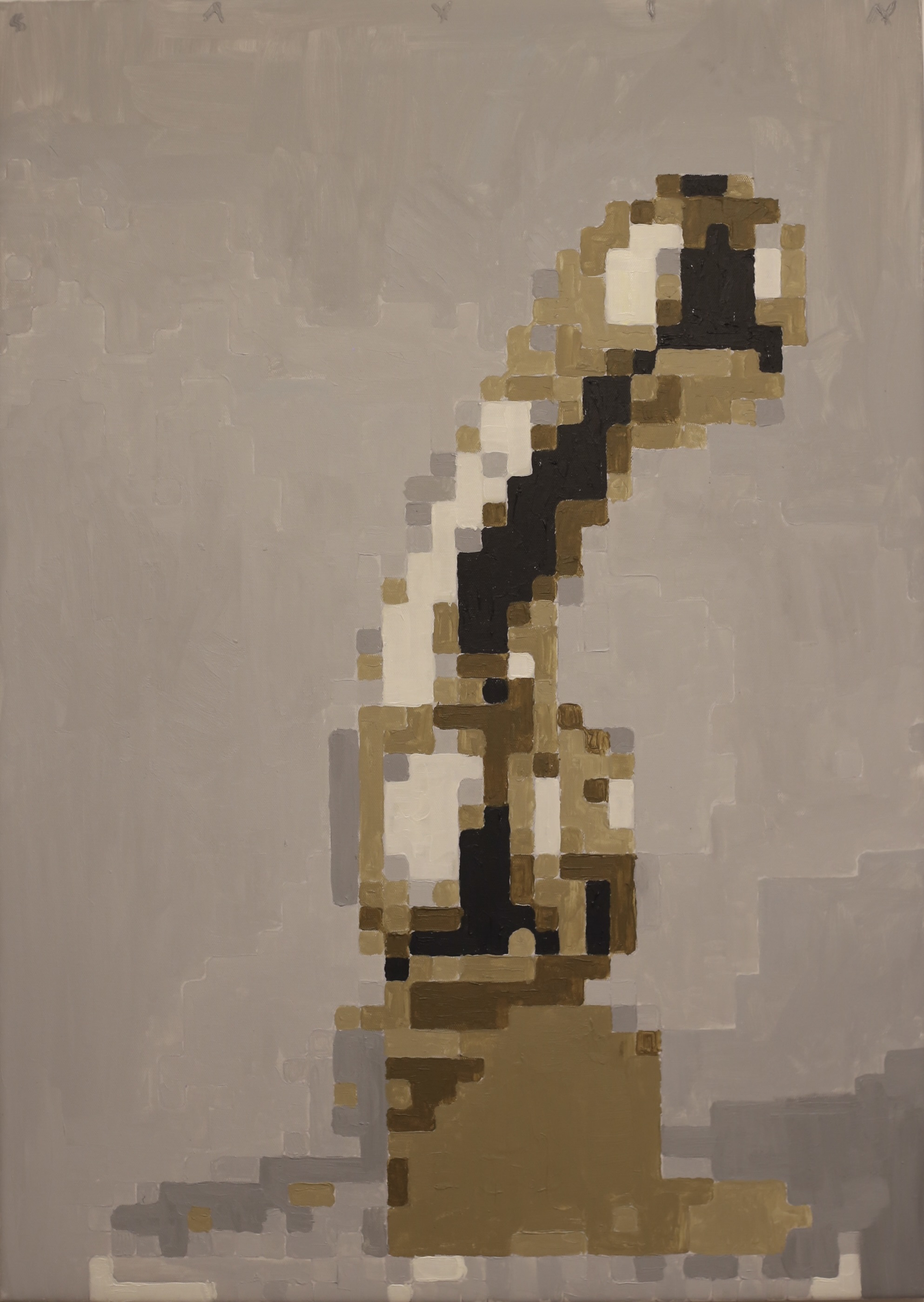
Public engagement culminated in an unsolicited yet lucid intervention, in which an online viewer rotated the image from portrait to landscape format, a gesture of minimal effort and maximal interpretive impact that rendered the suggested anatomical form more explicit. Subsequently, reflecting the contrast between institutional formality and the logic of the artwork, the post was also disseminated on Facebook by the Romanian UNESCO Parliamentary Commission, given that the organizing institution was a UNESCO partner.